
Jira by Atlassian is the world's most popular and complex platform for software development teams. However, some customers are still considering migrating to a reliable alternative platform. Among the main reasons are the cloud version only and increasing monthly payments.
Open-source software offers many advantages, including low cost, flexibility, transparency, community support, and reliability. Let's explore the most popular open-source platforms for the IT services team:
.
Running Jira Data Center or Server? Atlassian ends Data Center on March 28, 2029, and renewals stop on March 30, 2028. See how to migrate from Jira to Redmine and keep your data on your own server.
How to choose an open-source Jira alternative?
Before deciding to switch from Jira, it's essential to evaluate the following factors carefully:
- User interface. While Jira's interface is generally well organised and visually appealing, making it easy for users to navigate and find the information they need, it can be overwhelming for users who are new to project management tools or have limited technical experience.
- Data migration. Determine the most important data that needs to be migrated, including issues, projects, users, and custom fields. Use scripting languages like Python, Ruby, or Groovy to write scripts that interact with Jira's REST API and extract, transform, and load data into the new platform.
- Security. Jira employs data encryption to protect sensitive information both in transit and at rest. This helps prevent unauthorised access to your data. While Jira offers a robust set of security features, its cloud-only model can be a potential red flag for organisations with stringent data sovereignty, compliance, or control requirements.
- Integration compatibility. Jira features a vast marketplace of third-party plugins, providing a wide range of integrations for tools like Git, SVN, and project management apps. This flexibility allows users to tailor Jira to their specific needs and workflows. While Jira's API and webhooks provide flexibility, creating complex custom integrations can be time-consuming and require technical expertise.
- Technical support. Jira has a comprehensive knowledge base filled with articles, tutorials, and FAQs that can help users find answers to common questions and troubleshoot issues independently. Paid Jira plans often include priority support, which means that users can expect faster response times and more dedicated attention from Jira's support team. While Jira strives to provide timely support, response times can vary depending on the complexity of the issue and the volume of support requests.
- The monthly subscription cost for 25 users. Jira's pricing plans are scalable, meaning that organizations can easily adjust their user numbers and features as their needs change. For larger teams with many users or complex requirements, the cost of Jira can be significant. In addition to the base subscription fee, organisations may incur additional costs for add-ons, integrations, or customizations.
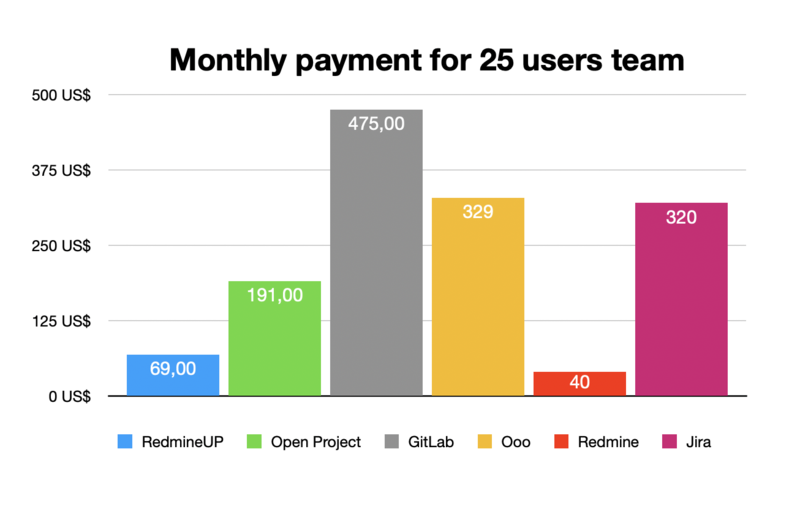
Open-source project management tools might be free, but they often come with restrictions. Leading tools often use the freemium model, providing a free version with limited functionality and user numbers. Let's compare pricing plans for a regular team of 25 users.
The most popular open-source Jira alternatives
1. RedmineUP
RedmineUP is open-source Redmine extended with professional plugins. It covers what most teams use Jira for, and a few things Jira needs extra apps for:
- Agile: Scrum and Kanban boards, sprints and burndown charts
- Service desk: email tickets, SLA and canned responses with the Helpdesk plugin
- Planning: Gantt chart, team workload and budgets
- Everyday work: custom fields and workflows, time tracking, checklists and a wiki in every project
- AI: an AI agent inside your Redmine
Run it where you want
Unlike Jira, RedmineUP doesn't push you into one deployment model. Run it on your own server, have us install and maintain it on your infrastructure, or use RedmineUP Cloud and let us handle hosting, backups and updates. Not sure which fits? Read our guide on choosing between cloud and self-hosting.
Peter Gaarde, Head of
Software Development It takes time to get into the ‘issue tracking mindset.’ We tried Jira and Trello, but if we had to go all-in, it would be more expensive, and it doesn’t have all the features inside, such as helpdesk or invoicing.
Moving from Jira
We migrate your Jira projects, issues, comments, attachments, custom fields and users, so your team keeps its full history. If you run Jira Data Center or Server, this is a way to keep your data on your own servers after Atlassian ends Data Center in 2029. See how the migration works
Best for: small and mid-sized teams that want Agile and classic project management in one tool, need control over where their data lives, or want to cut per-user costs.
Pricing: RedmineUP Cloud for teams of 25 starts at $69 per month. Plugins for your own server are a one-time purchase.
2. OpenProject
OpenProject is a comprehensive open-source project management platform that offers a variety of features, including issue tracking, Kanban and Scrum boards, Gantt charts, time tracking, custom fields and workflows, and integrations with other tools. It's known for its powerful reporting capabilities and active community development.
OpenProject can be installed on-premises in your own organisations's infrastructure, giving you complete control over your data and allowing you to manage it 100% yourself. OpenProject is investing heavily in the freedom of users. This encompasses the software freedoms granted by GPLv3 and extends to the rights and freedoms granted by the General Data Protection Regulation (GDPR).
Install and run OpenProject on-premises in your organisation’s infrastructure and behind your firewall. This setup in your own infrastructure or hosting provider of your choice provides you most privacy and sovereignty over your data.
For teams of 25, enjoy monthly pricing starting at $191.
Create a free OpenProject account
3. GitLab
GitLab is a comprehensive DevSecOps platform focused on AI to empower Dev, Sec, and Ops teams. GitLab brings all DevSecOps capabilities into one application with a unified data store, so everything is all in one place.
| Feature | GitLab | Jira |
|---|---|---|
| Primary Function | Version control system (VCS) for source code management | Issue tracking and project management tool |
| Core Features | Git repository hosting, CI/CD, code review, issue tracking, project management | Issue tracking, project planning, bug tracking, task management, reporting |
| Integration | Seamlessly integrates with Git and other Git-based tools | Integrates with various development tools, including Git, but may require additional configuration |
| Target Users | Developers, DevOps engineers, project managers | Project managers, product owners, developers, QA engineers |
| Focus | Code development, collaboration, and deployment | Project planning, tracking, and reporting |
The best choice for your team depends on your specific needs and preferences. If you're looking for a comprehensive solution that covers your entire software development lifecycle, GitLab might be the better option. If you primarily need a tool for managing tasks and projects, Jira could be a good fit.
For teams of 25, enjoy monthly pricing starting at $725.
4. Odoo
Odoo is a popular open-source business management suite that offers a wide range of integrated applications to help businesses streamline their operations. From project management and CRM to accounting and inventory management, Odoo provides a comprehensive solution for organizations of all sizes.
| Feature | Odoo | Jira |
|---|---|---|
| Primary Function | Open-source business suite with integrated project management | Issue tracking and project management tool |
| Core Project Management Features | Task management, Gantt charts, resource planning, time tracking, collaboration | Issue tracking, task management, Kanban boards, Scrum boards, reporting |
| Integration | Integrates with other Odoo modules (CRM, ERP, e-commerce) | Integrates with various development tools (Git, GitLab, etc.) |
| Target Users | Project managers, business owners, sales teams, accounting teams | Project managers, product owners, developers, QA engineers |
| Focus | Comprehensive business management with integrated project management | Project planning, tracking, and reporting |
Ideal for teams seeking an integrated solution for a wide range of business processes, from sales and marketing to manufacturing and accounting.
For teams of 25, enjoy monthly pricing starting at $329.
5. Redmine
Redmine is a popular open-source project management application that offers a robust set of features for managing projects of all sizes. It provides a flexible and customisable platform that can be adapted to fit various project management methodologies.
Redmine is the cheapest option, but it has a limitation in that it doesn't have technical support behind it. Redmine's user interface is less modern than Jira's, and it may have fewer features. As an open-source tool, Redmine is free to use and offers significant cost savings compared to proprietary project management solutions.
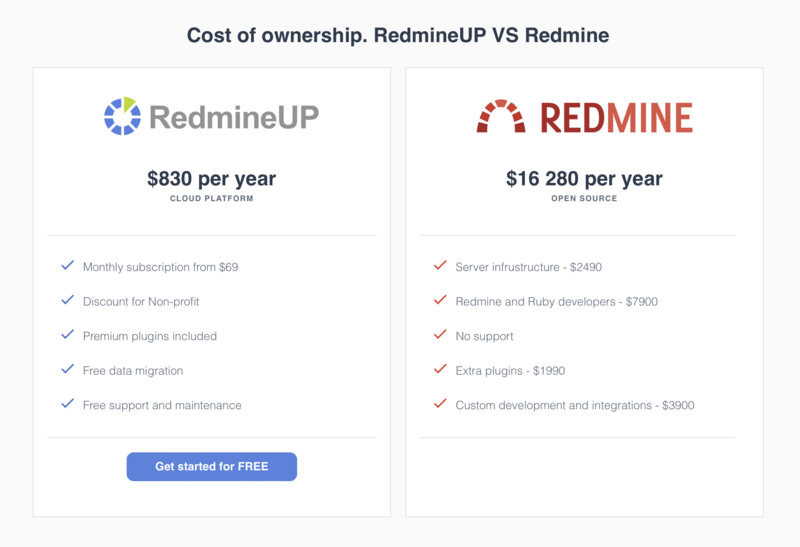
However, do not forget the cost of maintenance. Free open source software doesn't mean you get to use it for free. For example, compare the 1-year cost of Redmine on-premises maintenance and the RedmineUP cloud subscription.
Ready to leave Jira?
- Planning a migration? Tell us your user count and Jira setup, and we will send you a free plan with scope, timeline and cost. Get a free migration plan
- Still comparing tools? Try Redmine with RedmineUP plugins on your own: no credit card needed. Start a free trial