If you support customers, almost any help desk tool will do the job. If you support employees (password resets, laptop provisioning, access requests, outages, change approvals), you need something built for IT service management (ITSM), not customer support. .
Some IT teams also need to open the same system to outside parties (contractors, vendors, or external clients) so they can log their own requests, which brings a different requirement on top: role-based access control and a dedicated client-facing portal, not just an internal agent queue.
The two look similar on the surface (both are "ticketing systems"), but the workflows underneath are different: SLAs tied to severity and business impact, asset and configuration tracking, change and problem management, and integrations with directory services, monitoring, and DevOps tooling.
So what should actually be on an IT team's checklist? Cost structure matters most as headcount grows: per-agent versus flat or server-based pricing changes the economics completely once you're past a handful of people. ITIL depth comes next: do you need incident, problem, and change management as separate, linked workflows, or is a well-organized queue with SLAs enough? Asset and CMDB tracking saves real time once you're past a handful of employees: you'll want to know which laptop, license, or server a ticket relates to. Deployment control (cloud-only versus self-hosted) matters for regulated industries or data-residency requirements. And integrations (SSO/Azure AD, Slack/Teams, monitoring tools, and whatever your dev/ops team already uses to track work) decide how much friction agents feel day to day.
By 2026, though, one requirement has moved to the top of that list: AI. The tools IT teams are actually choosing now are the ones where AI handles first-line support, deflecting password resets, access requests, and routine "how do I" tickets before a human ever touches them, and acts as a co-pilot for agents on everything else, drafting replies, summarizing long threads, and suggesting a resolution pulled from past tickets. A platform without a real AI layer in 2026 is already behind, no matter how deep its ITIL workflows look on paper.
But as we move through 2026, most IT departments are re-checking this decision. Per-agent SaaS pricing that looked fine at 5 people starts to hurt at 15. Teams that adopted a generic helpdesk tool for lack of a better option are running into its ceiling on change management and asset tracking. And some are simply tired of a second SaaS vendor holding internal IT data.
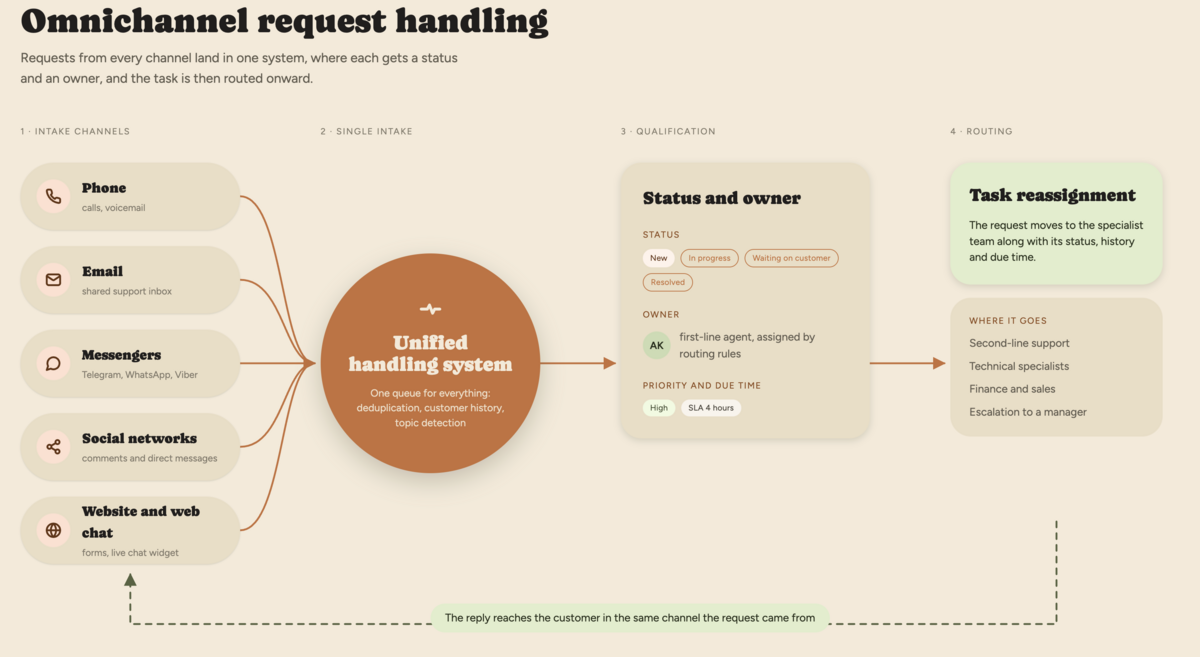
In this guide, we compare five ticket systems that are actually built (or configurable) for internal IT support, evaluated on pricing model, ITIL depth, asset/CMDB tracking, deployment control, and integrations. We left out pure customer-support tools like Freshdesk and Zoho Desk (they optimize for a different job) and ServiceNow (for most IT teams under a few hundred people, it's more platform than they need, priced accordingly).
Best ticket systems for IT departments in 2026
The right one depends on how formal your ITIL process needs to be, whether per-agent or flat pricing works better for your headcount, and whether self-hosting matters to you.
1. RedmineUP Helpdesk
RedmineUP takes a different approach from the rest of this list: instead of a fixed ITSM data model, it adds a Helpdesk module (SLA tracking, satisfaction ratings, email-to-ticket automation, a CRM-style view of each requester) on top of Redmine's flexible issue-tracking and workflow engine, then lets you shape ticket types, statuses, and workflows to match however your IT team actually works, including linking tickets directly to the same projects your ops/dev team already tracks.
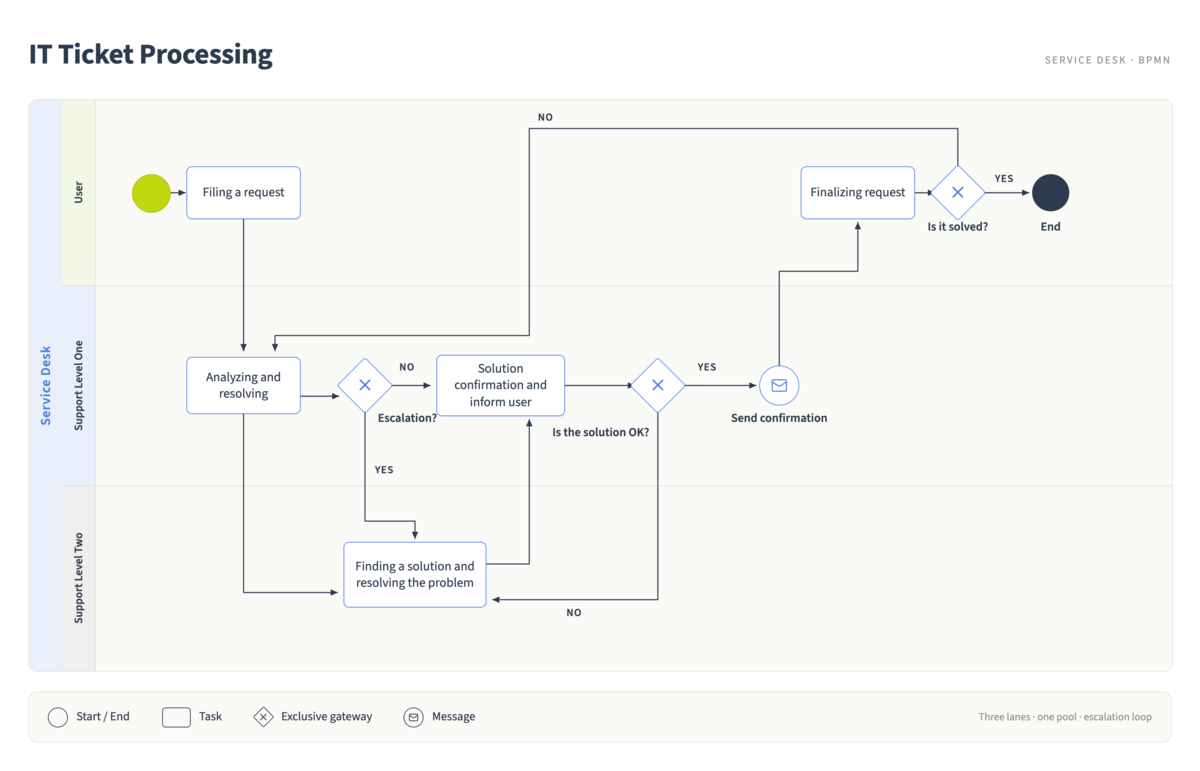
Pricing works two ways. RedmineUP Cloud starts at $69/month (billed annually) for the Small plan: 25 users, 25 active projects, and the full plugin bundle (Helpdesk, Agile, CRM, Checklists, and more) included, not priced per agent. Self-hosted, the Helpdesk plugin alone starts at $399/year per server (unlimited users on that server), or $1,799/year for the full 14-plugin bundle, a materially different economics curve than per-agent SaaS pricing once your team grows past a handful of people.
Strengths: pricing doesn't scale per agent, so it's often the cheapest option once an IT team passes 10-15 people; choice of cloud or fully self-hosted, useful for data-residency or air-gapped environments; and because it's built on Redmine, IT ticket workflows can share the same instance as engineering/ops project tracking.
Trade-offs: out-of-the-box ITIL structure is lighter than Jira Service Management or Freshservice: you configure workflows yourself rather than adopting a pre-built incident/problem/change model. If you want to see exactly how that configuration looks in practice, we cover it step by step in Adopting Redmine for ITSM: Incident Management. Teams whose support process is more collaborative than ticket-queue-driven may also want to look at how we turned a basic setup into a full Agile Helpdesk.
Ideal for: budget-conscious IT teams, organizations that want self-hosted control, and any company already running Redmine for engineering work that wants IT support in the same system rather than a separate SaaS tool.
Try RedmineUP for Helpdesk free for 30 days
2. Jira Service Management
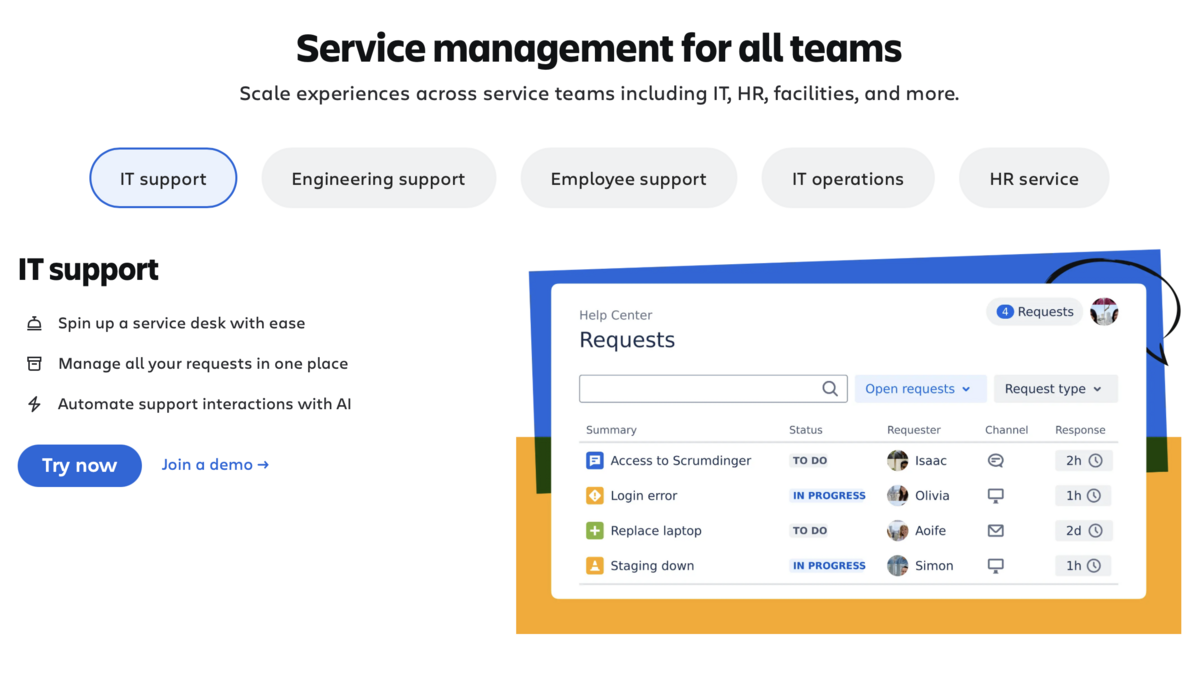
Atlassian's ITSM product is the default choice for IT teams that already run on Jira and Confluence, and it shows: incident, problem, and change management are first-class, linked objects, not bolted-on modules, and the free Rovo-powered search/AI assistant is baked into every paid tier from Standard up.
Pricing: free for up to 3 agents. Standard is $20/agent/month, with unlimited automation and up to 100,000 agents supported. Premium is roughly $51.42/agent/month and adds a virtual service agent, AIOps, and real-time incident monitoring. Enterprise is custom-priced.
Strengths: deep ITIL workflows, tight integration with Jira Software, a large marketplace of add-ons, and an asset/CMDB module from Standard up.
Trade-offs: configuration complexity is real; new admins often need training to set workflows up well, and pricing climbs quickly once you need Premium-tier incident management. If your team likes Jira's model but wants to avoid its cost curve, our open-source Jira alternatives roundup covers that angle in more depth.
Ideal for: IT departments inside companies that already use Jira for engineering work, or any team that wants the deepest ITIL feature set without moving to ServiceNow.
3. Freshservice
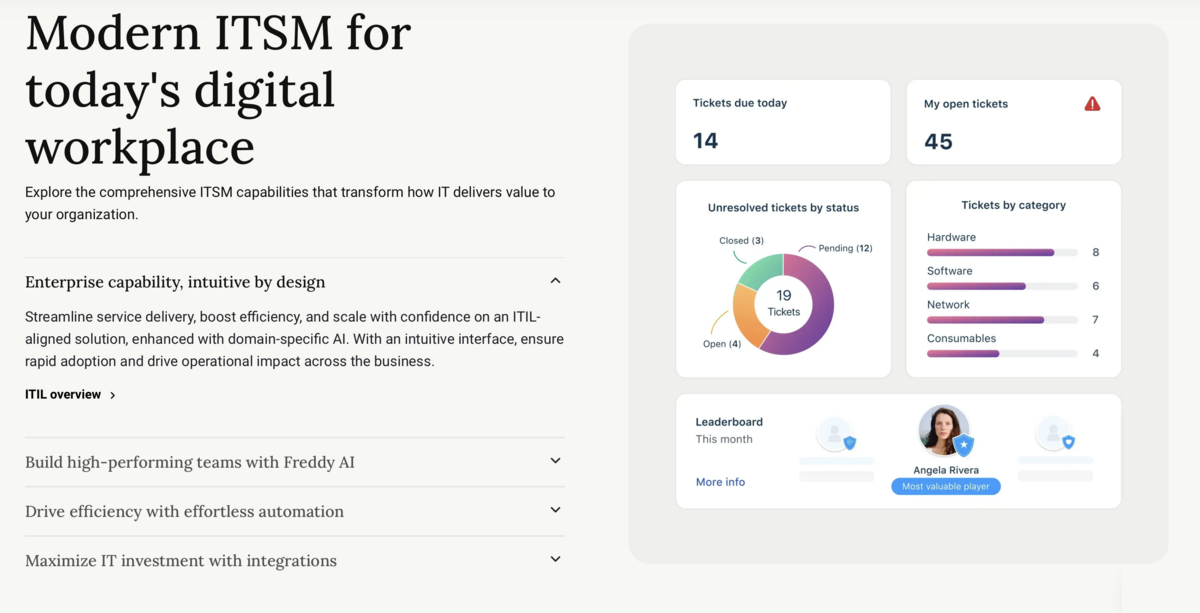
Freshworks' dedicated ITSM product (distinct from Freshdesk, which is customer-support focused) is built around a clean, modern interface and Freddy AI running across ticket summarization, resolution suggestions, and knowledge-base authoring.
Pricing: Starter is $19/agent/month with incident management, knowledge management, and basic multichannel support. Growth ($49/agent/month) adds a service catalog, SLA management, and on-call scheduling. Pro ($99/agent/month) unlocks problem management, change management, and major-incident handling. Enterprise is custom.
Strengths: fast to deploy, a genuinely pleasant UI, and ITIL-aligned workflows once you're on Growth or Pro.
Trade-offs: the feature set you actually need for proper ITSM (problem and change management) only shows up at the Pro tier, a meaningful jump from Starter.
Ideal for: mid-sized IT teams that want ITIL depth without Jira's configuration overhead, and are comfortable paying more once they need the full workflow set.
4. ManageEngine ServiceDesk Plus
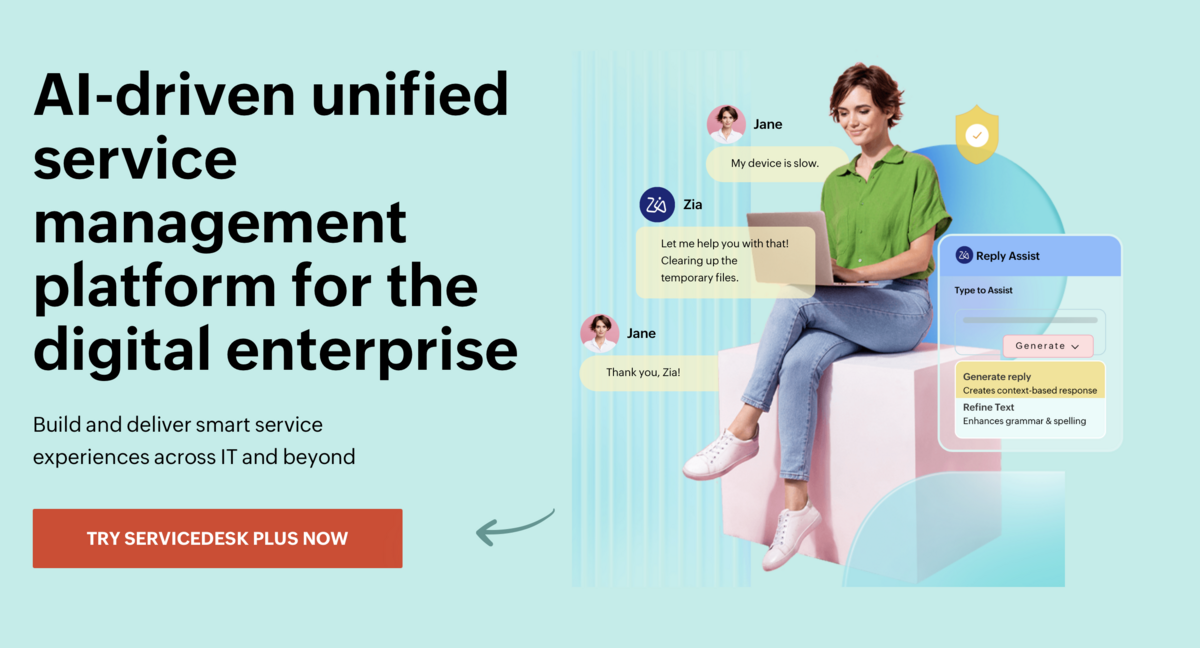
ManageEngine's ServiceDesk Plus is the option most likely to already be familiar to sysadmins, and it's one of the few tools here offering on-premise deployment at price parity with cloud, a real differentiator for regulated industries or teams that don't want another SaaS vendor holding IT ticket data.
Pricing: Standard starts around $13/technician/month (a free edition covers up to 5 technicians). Professional starts near $27/technician/month and adds asset management. Enterprise, from about $67/technician/month, bundles change, project, and release management with a full CMDB.
Strengths: strong asset and CMDB management even at mid tiers, flexible cloud-or-on-prem deployment with identical feature parity, and pricing noticeably lower than Jira SM or Freshservice at comparable depth.
Trade-offs: the UI feels more utilitarian than Freshservice's, and some ITSM capabilities are gated behind add-ons on lower tiers.
Ideal for: cost-conscious IT departments, especially ones that need or prefer on-premise hosting, that still want a full ITSM feature set.
5. Zendesk
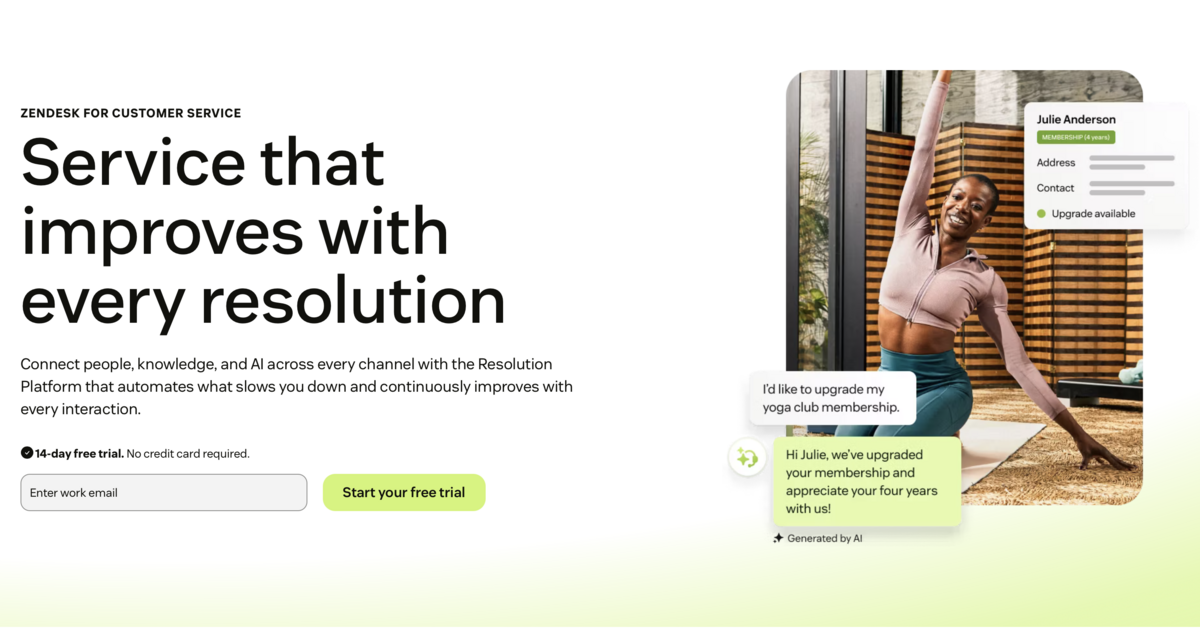
Zendesk is best known as a customer-support platform, but plenty of IT teams use it for internal tickets too, largely because it's fast to set up and the agent experience is polished. It's the least ITIL-native tool on this list, which is either a limitation or a feature depending on how heavyweight your process needs to be.
Pricing: Support Team starts at $19/agent/month for core ticketing. The Suite plans (knowledge base, omnichannel routing, AI agents) start at $55/agent/month for Team and $115/agent/month for Professional. Enterprise is custom. Zendesk has also moved part of its AI pricing to an outcomes-based model: you pay per successfully-resolved automated request rather than a flat per-agent AI fee.
Strengths: very fast time-to-value, strong automation and macros, and an interface agents generally like.
Trade-offs: no real incident/problem/change management out of the box: you're organizing internal IT work with tags, forms, and triggers rather than native ITSM objects. If your comparison is specifically Zendesk-shaped, we go deeper on open-source ways to route around its per-agent costs in Best 5 Open Source Zendesk Alternatives, and on pure customer-support ticketing in Best 5 open source helpdesk and ticketing systems.
Ideal for: small IT teams that want something simple and fast, or organizations already standardized on Zendesk for customer support who don't want a second tool for internal tickets.
Best 5 tickets systems in comparison
| System | Starting price | Free tier | ITSM depth | Deployment | Best for |
|---|---|---|---|---|---|
| RedmineUP | From $69/mo (Cloud, 25 users) or $399/yr (self-hosted) | 30-day trial | Moderate, highly customizable | Cloud or self-hosted | Budget-conscious teams, avoiding per-agent pricing |
| Jira Service Management | $20/agent/mo | Up to 3 agents | High: incidents, problems, changes, CMDB | Cloud / Data Center | Teams already on Atlassian/Jira |
| Freshservice | $19/agent/mo | 14-day trial only | High from Pro tier up | Cloud only | ITIL depth, low-friction UI |
| ManageEngine ServiceDesk Plus | $13/technician/mo | Free up to 5 technicians | High, especially Enterprise | Cloud or on-premise | On-prem, asset management, cost-conscious |
| Zendesk | $19/agent/mo (Support), $55+ (Suite) | 14-day trial only | Moderate | Cloud only | Simple, fast, not chasing formal ITIL |
Pricing shown is publicly listed as of September 2026, entry paid tier per agent/technician on annual billing unless noted. AI add-ons, overage fees, and enterprise tiers can change the real total, so always check current vendor sites before budgeting.
How to choose ticket system?
- You're already on Jira/Confluence and need deep ITIL workflows: Jira Service Management.
- You want ITIL depth with the least configuration pain, and per-agent SaaS pricing is fine: Freshservice.
- You want strong asset management and the option to keep data on-premise, at a lower price than Jira or Freshservice: ManageEngine ServiceDesk Plus.
- You need something simple and fast, and you're not chasing formal ITIL processes: Zendesk.
- Your team is growing past 10-15 agents and per-agent pricing is starting to hurt, or you want cloud-or-self-hosted flexibility and are fine configuring your own workflows: RedmineUP.
None of these is objectively "best": the right one depends on how formal your IT processes need to be, whether per-agent or flat pricing works better for your headcount, and whether self-hosting matters to you. If cost predictability as your team grows and deployment flexibility are the deciding factors, try RedmineUP for Helpdesk free for 30 days and compare it directly against whatever you're using today.